
Beginner roadmap
How to Learn Digital Marketing in 2026: Beginner's Roadmap
A clear, beginner-friendly roadmap for learning digital marketing in 2026 without drowning in random courses, tools, and platform advice.
Direct answer
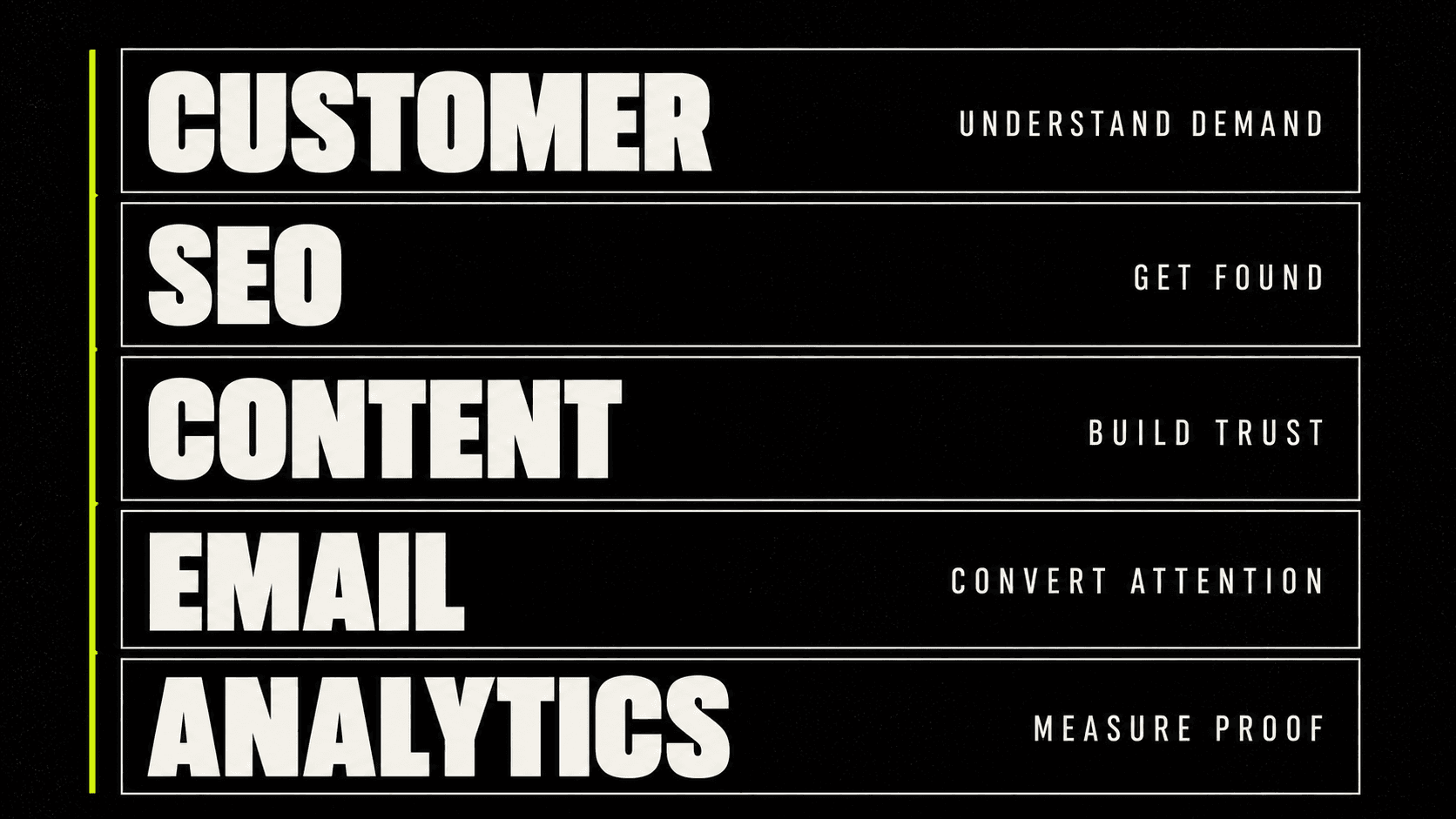
The best way to learn digital marketing in 2026 is to learn the marketing system before the tools. Start with customer psychology, offers, copywriting, search intent, content, landing pages, email, analytics, and AI-assisted workflow. Then pick one practice project and turn each skill into a visible asset: a customer research memo, SEO plan, content brief, landing page, email sequence, ad test plan, analytics dashboard, and portfolio case study. Courses, books, YouTube channels, and tools help, but they do not replace practice. A beginner who spends 90 days building one real project will usually understand more than a beginner who watches 90 hours of disconnected tutorials.
Key takeaways
- Learn customer, offer, copy, search, content, email, ads, analytics, and AI in that order.
- Use courses for structure, books for judgment, YouTube for examples, and projects for proof.
- Pick one practice project early. A portfolio case study beats a folder of course certificates.
- AI is now part of the workflow, but it works best after you understand research, positioning, and measurement.
- The goal is not to know every platform. The goal is to help a real audience discover, trust, and act on a real offer.
Who this is for
- Students and career switchers starting from zero.
- Freelancers who want a practical service skill stack.
- Founders and creators who want to market their own work.
- Beginners in India or global remote markets who need portfolio proof before applying.
- Readers who want a structured alternative to random YouTube playlists.
What you will build
- A 90-day learning roadmap.
- A customer research memo and search-intent map.
- A landing page, content plan, email sequence, and ad brief.
- A simple analytics plan and portfolio case study.
- A realistic tool stack that includes AI without turning your work generic.
Plain-English definitions
- Digital marketing
- Digital marketing is the work of using online channels to help the right people discover, trust, and act on an offer. It includes SEO, content, social, paid ads, email, analytics, conversion, and AI-assisted workflows.
- Search intent
- Search intent is the reason behind a query. A person searching 'what is SEO' needs education; a person searching 'SEO audit service near me' may be ready to buy.
- Portfolio proof
- Portfolio proof is finished work that shows your thinking: research, strategy, copy, content, measurement, and what you would improve next.
Introduction
Digital marketing is one of the easiest fields to start learning and one of the easiest fields to learn badly. That is the problem. A beginner can open YouTube, watch an SEO tutorial, copy a social media content calendar, run through a Google Ads lesson, ask ChatGPT for a marketing plan, and still not understand why a customer buys.
This roadmap fixes the order. You will not start with every tool. You will start with the business job behind the tool: finding a specific audience, understanding what they want, making a clear offer, earning trust, creating a useful path to action, and measuring what happened.
The article is written for a complete beginner in 2026. That means AI matters. Google AI features, ChatGPT, Claude, Perplexity, short-form video, first-party data, attribution limits, and crowded platforms all matter. But the foundations still matter more. A person who understands customer psychology and can write a clear page will use AI better than a person who only collects prompts.
Use this as a practical learning plan. Read it once for the map. Then pick one project and work through the steps. Digital marketing becomes real only when you ship something a recruiter, client, founder, or customer can inspect.
What Is Digital Marketing?
Digital marketing is the use of online channels to attract people, build trust, present an offer, and measure action. The channel can be Google Search, YouTube, Instagram, LinkedIn, email, paid ads, a website, a landing page, an ecommerce store, an app, a webinar, a lead magnet, or an AI-search result.
A useful definition has to include measurement. If you post content but never know whether it brought the right people closer to the offer, you are doing online activity, not serious marketing. Marketing connects the message to a business or audience goal.
For a beginner, digital marketing has four moving parts. The customer has a need. The offer promises a result. The channel carries the message. The measurement tells you whether the message helped. Once you understand those four parts, the tools become easier to sort.
A simple example
Imagine a local fitness coach in Pune who wants more trial bookings. Digital marketing is not just posting workout reels. It might include a Google Business Profile, a page for 'personal trainer in Pune,' before-and-after proof, a WhatsApp inquiry button, a short email or message follow-up, and a tracking sheet for leads and bookings.
The same system works for a book, an ecommerce product, a SaaS trial, a newsletter, or a consulting offer. The language changes. The channels change. The underlying job stays the same: help the right person move from problem to decision.
Why Learn Digital Marketing from Scratch in 2026?
Digital marketing remains valuable because the internet did not remove competition. It increased it. Every brand, creator, local business, freelancer, SaaS company, ecommerce store, and educator needs attention and trust. The crowded part is beginner-level noise. The valuable part is judgment.
The U.S. Bureau of Labor Statistics projects advertising, promotions, and marketing manager employment to grow 6 percent from 2024 to 2034, with about 36,400 openings per year. That does not guarantee any individual job. It does show that marketing management and demand generation remain real business functions.
For India and other competitive beginner markets, digital marketing is useful because it can create proof without waiting for permission. You can audit a public website, write a content brief, create a landing page, build a sample email sequence, or improve your own project. That proof can support a job application, freelance pitch, creator business, or startup.
AI makes the field more demanding, not useless. Tools can draft faster than beginners. That means beginners need to learn the parts AI cannot own: customer understanding, offer judgment, source verification, taste, ethics, measurement, and responsibility for results.
- Learn it if you want a practical business skill.
- Learn it if you like writing, research, psychology, data, or experimentation.
- Learn it if you want to market your own project or business.
- Be cautious if you only want a quick certificate or guaranteed income.
What Do Digital Marketers Actually Do?
Digital marketers do not spend the whole day making posts. That is one task inside one channel. A serious digital marketer studies customers, plans campaigns, writes briefs, creates or improves assets, coordinates with designers and developers, reads analytics, runs experiments, reports what changed, and decides what to fix next.
At junior level, the work may include keyword research, content uploads, social scheduling, email drafts, basic reports, competitor research, ad copy variations, landing page edits, or CRM cleanup. At mid level, the work becomes more strategic: channel planning, conversion improvement, budget allocation, campaign measurement, lifecycle flows, SEO roadmaps, creative testing, and stakeholder communication.
The daily reality depends on the role. An SEO specialist may spend time in Search Console, Ahrefs, Screaming Frog, content briefs, internal links, and technical tickets. A social media manager may work on content calendars, community replies, creator coordination, short-form video, and performance reports. A performance marketer may work inside Google Ads, Meta Ads, landing pages, tracking pixels, and budget spreadsheets. An email marketer may write flows, segment audiences, monitor deliverability, and improve click behavior.
The shared skill is decision-making. A digital marketer has to ask: who is this for, why should they care, what should they do next, and how will we know if it worked?
The Main Types of Digital Marketing
You do not need to master every channel at once. You should understand the main types so you can choose a path and see how the pieces connect.
1. Search Engine Optimization, or SEO
SEO helps pages become easier for search engines and people to understand. In practice, it includes search intent, keyword research, useful content, internal links, technical crawlability, page experience, and authority signals.
Google's SEO Starter Guide frames SEO as improving a site's presence in Search through practical improvements. In 2026, SEO also has to account for AI Overviews and AI Mode, but Google's own AI-search guidance still points back to helpful, reliable, people-first content and standard SEO fundamentals.
2. Content Marketing
Content marketing uses useful articles, videos, guides, templates, newsletters, case studies, and social posts to educate people and build trust before the sale. Good content does not exist only to fill a calendar. It answers real questions and helps the audience make a better decision.
A beginner should practice content marketing by writing one strong helpful page, not by publishing thirty generic posts. Learn how to define the reader, choose the question, structure the answer, cite sources, and connect the piece to a next step.
3. Social Media Marketing
Social media marketing uses platforms such as Instagram, LinkedIn, YouTube, TikTok, X, Facebook, and communities to distribute ideas and interact with an audience. It can build awareness, trust, conversations, and demand.
The mistake is treating social media as random posting. A useful social strategy has a point of view, content pillars, format choices, engagement habits, and a conversion path. A creator who gets attention but has no email list, offer, or next step owns less than they think.
4. Paid Advertising
Paid advertising buys attention through platforms such as Google Ads, Meta Ads, YouTube Ads, LinkedIn Ads, and marketplace ads. Paid ads can test demand faster than SEO, but they also expose weak offers fast. If the landing page, audience, tracking, or economics are bad, paid ads burn money.
Beginners should learn paid ads with small budgets, simulations, or supervised projects. Learn campaign structure, targeting, creative, landing pages, conversion tracking, and reporting before promising results to a client.
5. Email Marketing
Email marketing builds a direct relationship with people who gave permission to hear from you. It includes lead magnets, welcome sequences, newsletters, product launches, abandoned cart flows, segmentation, and retention campaigns.
Email is a strong beginner skill because it teaches copy, sequencing, trust, and measurement. A five-email welcome sequence can become a portfolio asset even when you do not have an ad budget.
6. Analytics and Measurement
Analytics tells you what happened. Measurement tells you what to do next. Tools such as GA4, Search Console, Looker Studio, ad platform reports, CRM reports, and email dashboards help marketers avoid guessing.
A beginner does not need advanced analytics on day one. Learn sessions, users, events, conversions, click-through rate, cost per click, cost per lead, open rate, reply rate, conversion rate, and revenue where available. More important, learn which number answers which decision.
7. Conversion Rate Optimization
Conversion rate optimization, or CRO, improves the percentage of visitors who take the desired action. It can include clearer headlines, stronger proof, shorter forms, better page speed, improved CTAs, better offer framing, and reduced friction.
CRO is where research, copy, design, analytics, and psychology meet. A beginner can practice it by rewriting a landing page and explaining which objections the new copy answers.
The Core Skills You Need to Learn Digital Marketing from Scratch in 2026
The core skills are not tools. They are the thinking skills that make tools useful.
1. Marketing Fundamentals
Marketing fundamentals include audience, problem, offer, positioning, differentiation, proof, channel, and measurement. Without them, you will copy tactics without understanding why they work.
Practice by choosing one product and writing answers to these questions: who is this for, what problem does it solve, what alternatives does the buyer compare, why should they trust it, and what action should they take next?
2. Copywriting
Copywriting is the skill of using words to create understanding and action. It is not hype. Good copy clarifies the buyer's problem, makes the offer concrete, handles objections, and asks for a reasonable next step.
Start by rewriting headlines, value propositions, product descriptions, CTAs, and email subject lines. Keep a swipe file, but do not blindly copy it. Ask why each line works.
3. SEO and Keyword Research
SEO and keyword research teach you how demand appears in language. A keyword is not just a phrase. It is evidence that someone has a question, problem, comparison, or buying need.
Learn search intent before tool metrics. A low-volume keyword with strong buying intent can matter more than a big generic keyword that brings the wrong visitors.
4. Content Creation
Content creation means turning research into useful formats: articles, videos, carousels, newsletters, case studies, guides, and short posts. The goal is not volume. The goal is usefulness plus distribution.
A beginner should learn how to create one strong long-form asset, then repurpose it into shorter formats. That teaches depth and distribution together.
5. Paid Ads
Paid ads teach offer clarity, audience selection, creative testing, landing page fit, and budget discipline. Learn the basics of Google Ads and Meta Ads, but do not skip tracking.
Never judge paid ads only by clicks. Clicks are easy to buy. Qualified leads, purchases, booked calls, and profitable acquisition are harder and more useful.
6. Analytics
Analytics helps you separate what feels good from what works. Learn GA4, Search Console, ad reports, email reports, and simple spreadsheets. You do not need fancy dashboards at first. You need useful questions.
Useful beginner questions include: where did visitors come from, what did they do, where did they stop, which page or email created action, and what should we test next?
7. AI and Automation
AI is now a normal part of marketing work. Use it for research questions, summaries, first drafts, content repurposing, ad variations, prompt-based analysis, and workflow automation.
Do not let AI invent facts, testimonials, statistics, or case studies. Your value comes from judgment. AI should make you faster at the work, not less accountable for it.
Best Online Courses to Learn Digital Marketing in 2026
Courses are useful when they provide structure. They are weak when you treat them as a substitute for projects. The best approach is to pair one course with one visible project.
The options below are strong starting points because they come from official platforms, major universities, or established marketing tool companies. Check pricing and certificate rules before enrolling because course platforms change often.
How to choose the right course
- Choose one broad beginner course first, not five at the same time.
- Check whether the course includes projects or only videos.
- Check whether the certificate matters for your target role.
- Build a portfolio asset for every major module.
- Stop taking courses if you have no finished work to show.
| Course | Best for | How to use it |
|---|---|---|
| Google Digital Marketing & E-commerce Professional Certificate | Beginners who want a broad structured path | Use it for foundations, then build a portfolio project alongside it. |
| Google Fundamentals of Digital Marketing on Skillshop | Free Google-led basics | Use it to understand channels, AI tools, video, search, data, and strategy. |
| HubSpot Academy Digital Marketing Certification | Inbound, content, SEO, social, and email basics | Use it for human-centered, inbound-first marketing language. |
| Meta Social Media Marketing Professional Certificate | Social media career path | Use it if you want social strategy, campaign work, and Meta ecosystem exposure. |
| Semrush Academy | SEO, content, PPC, competitive research | Use it after learning fundamentals to sharpen channel-specific skills. |
| Ahrefs SEO Course for Beginners | SEO basics | Use it for keyword research, on-page SEO, link building, and ranking concepts. |
| Coursera Digital Marketing Specialization by University of Illinois | Academic-style digital marketing overview | Use it if you prefer structured university-led learning. |
| The Complete Digital Marketing Course, 12 Courses in 1 on Udemy | Budget-friendly tool exposure | Use it selectively; do not confuse many modules with mastery. |
| Wharton Fundamentals of Digital Marketing, Social Media and E-Commerce | Strategic and business-focused learning | Use it if you want executive-level framing and can justify the cost. |
| Google Ads and Google Analytics Certifications on Skillshop | Platform credentials | Use them after you understand tracking and campaign basics. |
Best Books to Learn Digital Marketing, Marketing Psychology and Content Strategy
Books are slower than videos, but they give you judgment. The best marketing books teach you how buyers think, how messages spread, how stories clarify offers, and how content earns trust. Digital platforms change every year. Human decision-making changes more slowly.
Use books to build your mental model. Use courses and tools to learn current interfaces.
1. Digital Marketing All-in-One For Dummies
This is useful when you want a broad reference. It will not make you an expert in every channel, but it gives beginners vocabulary and context across the field.
2. Digital Marketing For Dummies
A lighter starting point for readers who want basic digital marketing concepts without committing to a huge program. Treat it as an orientation, then practice.
3. They Ask, You Answer by Marcus Sheridan
This book is valuable for content marketing because it teaches a simple principle: answer the questions buyers are already asking. That mindset fits SEO, sales enablement, landing pages, and AI-search visibility.
4. Building a StoryBrand by Donald Miller
This is useful for offer clarity. Beginners often write from the company's perspective. StoryBrand pushes you to make the customer the center of the message.
5. Everybody Writes by Ann Handley
Useful for content, email, newsletters, and brand writing. Digital marketing requires writing even when your job title is not writer.
6. Influence by Robert Cialdini
A classic psychology book for understanding persuasion. Read it ethically. The goal is not manipulation; the goal is to understand how trust, proof, scarcity, authority, and commitment affect decisions.
7. Contagious by Jonah Berger
Useful for understanding why some ideas spread. It helps social media and content marketers think beyond posting frequency.
8. Made to Stick by Chip Heath and Dan Heath
Useful for making messages memorable. It teaches simplicity, unexpectedness, concreteness, credibility, emotion, and stories.
Best YouTube Channels and Free Resources to Learn Digital Marketing
YouTube is useful for examples and interface walkthroughs. The risk is endless watching. Use YouTube with a task. Watch one video, then apply it to your project the same day.
1. Google Search Central YouTube Channel
Use it for official search explanations, office hours, and updates around Google Search. Pair it with the SEO Starter Guide so you do not rely only on creator opinions.
2. Ahrefs YouTube Channel and SEO Course
Ahrefs is strong for SEO examples, keyword research, content, link building, and practical site growth. Their beginner SEO course is a good first SEO path.
3. HubSpot Marketing YouTube Channel
HubSpot is useful for inbound marketing, CRM, content, sales alignment, and email basics. It is especially good when you want business context around marketing.
4. Neil Patel YouTube Channel and Free Training
Neil Patel's content can help beginners understand broad marketing tactics and SEO vocabulary. Use it as one perspective, not your only source.
5. Google Search Central SEO Starter Guide
This should be bookmarked. It is not flashy, but it gives Google's own explanation of common SEO improvements.
6. HubSpot Academy
HubSpot Academy is one of the best free libraries for inbound, content, email, social, CRM, and digital marketing basics.
7. Meta Blueprint
Meta Blueprint is the official place to learn Facebook, Instagram, Reels placements, creative, targeting, campaign setup, and business tools.
8. Mailchimp Academy
Mailchimp Academy is useful if you want to understand email marketing, automation, audience management, and platform workflows.
Best Digital Marketing Tools to Learn in 2026
Tools change. Categories matter more than brand names. Learn what each tool category is for, then choose based on your budget and project.
1. SEO and Keyword Research Tools
Start free with Google Search Console, Google Trends, Google autocomplete, People Also Ask, and the live search results. Paid tools such as Ahrefs, Semrush, Moz, and Ubersuggest can help with keyword ideas, competitors, backlinks, and site audits.
Do not let a paid tool make decisions for you. A keyword with intent and business fit matters more than a keyword that looks large in a dashboard.
2. Analytics Tools
Learn GA4, Search Console, Looker Studio, spreadsheet basics, and platform dashboards. A beginner should know how to track page visits, events, conversions, traffic sources, search queries, email clicks, and campaign performance.
Analytics is not about making pretty dashboards. It is about answering decisions.
3. Social Media Tools
Use native platform analytics first. Later, tools such as Buffer, Hootsuite, Later, Metricool, or Sprout Social can help with scheduling and reporting. For a beginner, the most important social media tool is still a clear content system.
4. Email Marketing Tools
Beginner-friendly options include Mailchimp, Brevo, ConvertKit, Beehiiv, MailerLite, and HubSpot. Learn list building, consent, segments, forms, automations, deliverability basics, and reporting.
Do not start email by designing a newsletter template. Start by asking why someone would subscribe and what useful thing they should receive first.
5. AI Tools for Digital Marketing in 2026
ChatGPT, Claude, Gemini, Perplexity, NotebookLM, Canva, Descript, CapCut, and platform-native AI tools can support research, drafting, summarizing, editing, repurposing, and production.
Use AI with source material. Give it customer reviews, transcripts, product notes, analytics observations, or competitor findings. Generic prompts produce generic marketing.
Step-by-Step Roadmap to Learn Digital Marketing from Scratch in 2026
This roadmap is designed for 90 days of practical learning. Adjust the timeline if you have fewer hours per week. The order matters more than the speed.
Learn the Basics of Marketing
Study customer, problem, offer, positioning, proof, channel, and measurement. Write a one-page explanation of a real business before touching tools.
Learn the Main Digital Marketing Channels
Understand SEO, content, social, paid ads, email, analytics, and CRO. Learn what each channel is for and when it is the wrong choice.
Pick One Practice Project
Choose a local business, creator, ecommerce product, nonprofit, personal site, or book page. Keep the same project for at least 90 days.
Learn SEO and Content Deeply
Create a search-intent map, choose topics, write one helpful page, add internal links, and measure indexing, impressions, clicks, and signups.
Learn Social Media and Short-Form Content
Turn your long-form idea into short posts, carousels, scripts, and discussion prompts. Track saves, comments, clicks, replies, and audience quality.
Learn Paid Ads with Small Budgets
Study campaign structure, targeting, creative, landing pages, and conversion tracking. Write a campaign brief before spending money.
Learn Email Marketing
Create a simple lead magnet, signup form, delivery email, and five-email welcome sequence. Track deliverability, opens, clicks, replies, and unsubscribes.
Learn Analytics
Set up simple measurement. Decide the input, leading indicator, outcome, and review cadence for each channel.
Build a Portfolio
Package your research, assets, screenshots, decisions, and measurement plan into a case study. Label practice work honestly.
Monetize the Skill
Choose one path: job, internship, freelance service, blog, affiliate site, personal brand, agency, consulting, or digital product.
How to Monetize Digital Marketing Skills
Do not monetize too early with vague promises. Monetize when you can deliver a clear outcome, a clear asset, or a clear improvement.
1. Freelancing
Start with narrow services: SEO audits, landing page rewrites, Google Business Profile cleanup, email welcome sequences, content calendars, analytics setup, or ad account audits. Narrow services are easier to price, sell, deliver, and turn into testimonials.
2. Jobs and Internships
Use your portfolio case study to apply for internships, entry-level roles, or apprenticeships. Show the project, not just the certificate. Explain the decisions you made and what you would measure next.
3. Blogging and Affiliate Marketing
Blogging can work when you choose a real niche, answer useful questions, build topical authority, and earn trust before recommending products. It is slow at first. Treat it as a long-term asset, not fast money.
4. Personal Brand
A personal brand is not motivational posting. It is repeated proof of how you think. Share teardown notes, before-and-after rewrites, project lessons, checklists, and useful frameworks.
5. Agency or Consulting
Do not rush into an agency before you understand delivery. Consulting requires diagnosis, scope control, communication, reporting, and trust. Learn service delivery as a freelancer first.
6. Selling Digital Products
Digital products work when you understand a specific problem and can create a useful resource, template, mini-course, or toolkit. Use your own marketing skills to validate demand before building.
Why Digital Marketing Is Still Valuable in 2026 Despite AI
AI can draft, summarize, remix, analyze, and automate. It cannot decide what your business should stand for. It cannot know whether your offer is ethical. It cannot verify a claim unless you give it sources and check the answer. It cannot own the relationship with a customer. It cannot take responsibility for the result.
Google's guidance for generative AI features still points publishers toward useful, reliable, people-first content and standard SEO fundamentals. That should calm beginners. You do not need a secret AI-search trick. You need better content, clearer structure, stronger sources, original examples, and a point of view worth citing.
The marketer who wins in 2026 will use AI as an assistant. They will use it to speed up research, drafting, repurposing, reporting, and brainstorming. Then they will add the part that AI does not have: accountability, context, taste, and real-world judgment.
Beginner Projects to Build Your Digital Marketing Portfolio
A portfolio should show finished work. It does not need to show paid clients on day one. It does need honesty.
| Project | What it proves | Finished asset |
|---|---|---|
| SEO audit | Search intent, prioritization, technical awareness | PDF or web case study |
| Content plan | Audience understanding and topic strategy | 30-day content map |
| Landing page rewrite | Offer clarity and conversion thinking | Before-and-after page |
| Email welcome sequence | Lifecycle copy and trust building | Five-email sequence |
| Ad campaign brief | Audience, creative, budget, and measurement thinking | One-page campaign plan |
| Analytics plan | Measurement judgment | Events, KPIs, and review cadence |
| AI-assisted workflow | Modern production process | Prompt, source, draft, edit, and QA log |
Best Book to Learn Digital Marketing from Scratch in 2026
If you want one structured companion after this roadmap, the site owner's recommendation is The Digital Marketing Blueprint by Abhishek Ashtekar. This is a transparent recommendation: the book is written by the owner of this website, and this site exists to support the book.
The reason it fits this article is structure. It covers customer psychology, SEO, content, social media, email, paid ads, analytics, AI workflows, freelancing, and career direction in one beginner-first sequence. Use the book if you want the full system and the free companion Resource Pack. Do not use it as a substitute for action. The value comes from applying each section to one real project.
Conclusion
Learning digital marketing in 2026 is worth it if you treat it as a practical craft. Learn the customer. Understand the offer. Write clearly. Build useful pages and content. Learn search. Learn email. Learn paid ads carefully. Measure what happens. Use AI to speed up the work, but keep your judgment awake.
The beginner who wins is not the one who watches the most tutorials. It is the one who builds the clearest proof. Pick one project. Work through the roadmap. Build the assets. Write the case study. Then decide whether you want a job, a freelance service, a business growth system, a creator path, or a deeper specialization.
Final Thoughts
Do not wait until you feel ready. Pick a project small enough to finish this month. Rewrite one page. Build one content brief. Write one email sequence. Create one measurement plan. That is how digital marketing stops being theory.
If you want the cleanest next step, use the free Resource Pack on this site and turn this article into a 90-day project. Your first case study matters more than your next saved playlist.
FAQ
Quick answers
How do I start learning digital marketing in 2026?
Start with marketing fundamentals, customer research, and copywriting. Then learn SEO, content, email, paid ads, analytics, and AI workflows through one practice project. Do not begin by trying to master every tool.
Can I learn digital marketing for free?
Yes. Google Skillshop, HubSpot Academy, Google Search Central, Ahrefs Academy, Meta Blueprint, and YouTube can teach a lot for free. The missing piece is usually practice, not information.
How long does it take to learn digital marketing?
A focused beginner can understand the system in a few weeks and build a useful portfolio project in about 90 days. Professional-level skill takes longer because it needs feedback, repetition, and real constraints.
Which digital marketing skill should I learn first?
Learn customer research and copywriting first. After that, choose one channel based on your goal: SEO and content for low-budget portfolio proof, paid ads for performance roles, social for creators, or email for owned audience and retention.
Is digital marketing still worth learning with AI?
Yes, but the bar is higher. AI can create first drafts and automate routine tasks. It cannot replace customer judgment, offer strategy, ethical claims, source verification, measurement, and responsibility for outcomes.
Do I need paid tools to learn digital marketing?
No. Start with free tools: Google Search, Search Console if you have a site, GA4, Google Trends, spreadsheets, platform analytics, free course libraries, and one AI assistant. Pay for tools when a real project needs them.
What should I put in a beginner digital marketing portfolio?
Include a customer research memo, SEO audit, content plan, landing page rewrite, email sequence, ad brief, analytics plan, and one case study that explains your decisions. Label practice work honestly.
Sources and further reading
- Google Digital Marketing & E-commerce Professional CertificateCoursera
- Fundamentals of Digital MarketingGoogle Skillshop
- Digital Marketing Certification CourseHubSpot Academy
- Meta Social Media Marketing Professional CertificateCoursera
- Semrush AcademySemrush
- SEO Course for BeginnersAhrefs Academy
- Digital Marketing SpecializationUniversity of Illinois on Coursera
- Fundamentals of Digital Marketing, Social Media, and E-CommerceWharton Executive Education
- Search Engine Optimization Starter GuideGoogle Search Central
- Optimizing your website for generative AI features on Google SearchGoogle Search Central
- Meta BlueprintMeta
- Mailchimp AcademyMailchimp
- GA4 Analytics AcademyGoogle Analytics Help
- Advertising, Promotions, and Marketing ManagersU.S. Bureau of Labor Statistics