
Copy system
Email and Landing Page Copywriting Guide for Beginner Marketers
Copywriting is not decoration. It is the skill that turns a visitor into a subscriber, lead, buyer, or reply.
Direct answer
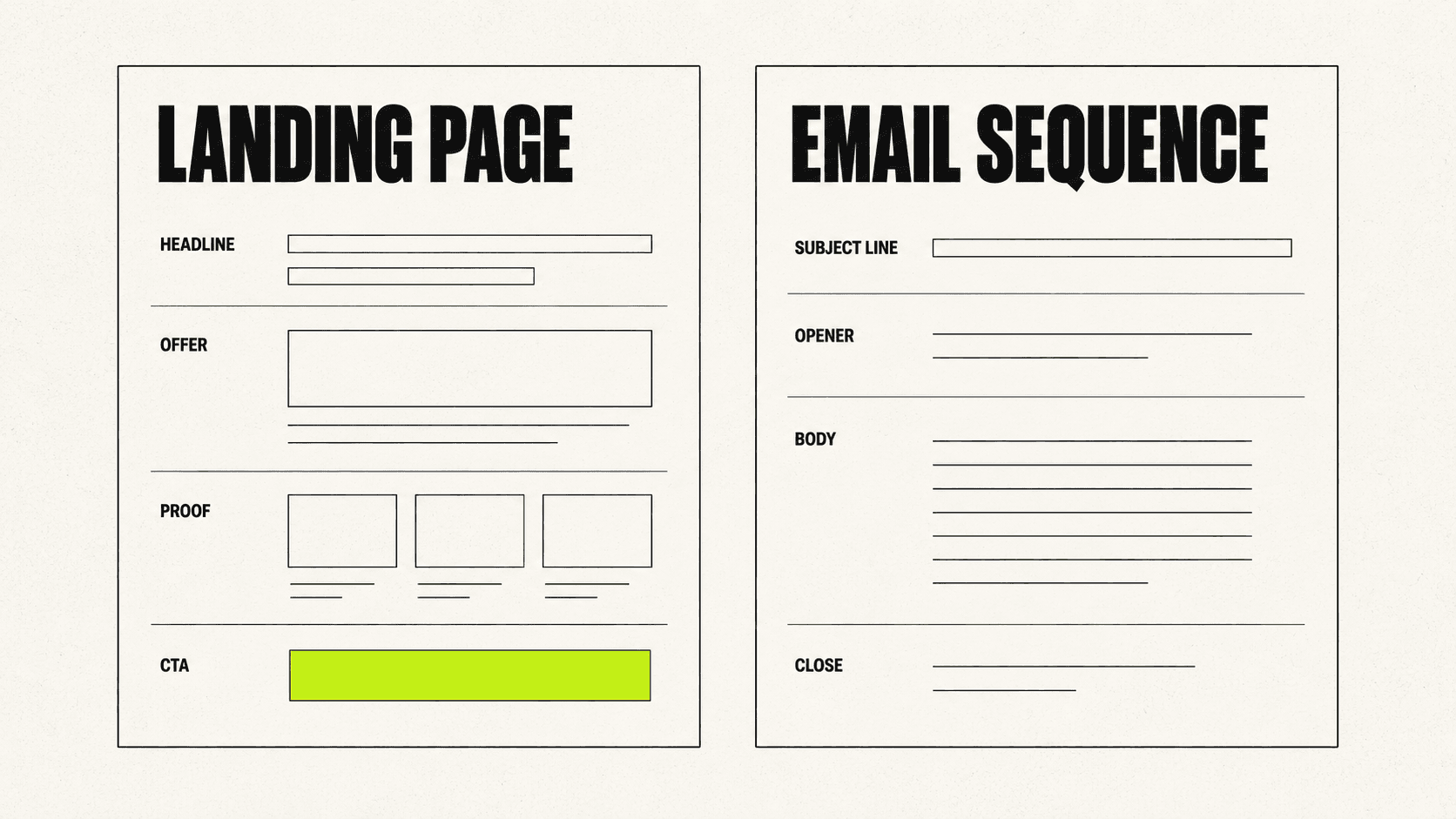
A strong landing page and email sequence should make one promise to one specific audience, prove that promise, reduce the biggest objections, and ask for one clear next action. The landing page does the first conversion job: it explains the problem, presents the offer, shows proof, answers risk, and makes the call to action easy. The email sequence does the follow-up job: it builds trust over several messages, teaches useful ideas, shows the reader why the offer matters, and invites action without sounding desperate. For beginners, the best system is simple: write the customer’s real sentence, write the outcome they want, list the proof they would believe, write the objections they carry, and then build the page and emails around those four inputs.
Key takeaways
- The best copy is specific, clear, and tied to one action.
- Landing pages need promise, proof, risk reduction, and CTA clarity.
- Welcome emails should build trust before asking for a larger commitment.
- Claims should be truthful, supportable, and not exaggerated.
Who this is for
- Beginners learning copywriting through practical deliverables.
- Freelancers who want to offer landing page or email services.
- Creators building a lead magnet and welcome sequence.
- Founders improving a simple sales or signup page.
What you will build
- A landing page outline.
- A 5-email welcome sequence.
- A proof and objection checklist.
- A CTA and measurement plan.
Plain-English definitions
- Conversion
- A meaningful action a visitor takes, such as signing up, buying, booking, downloading, or replying.
- Call to action
- The specific next step you ask the reader to take.
The four inputs before writing
If these four inputs are weak, the copy will sound generic. If they are sharp, the page practically writes itself.
- Customer sentence: what the person is really thinking.
- Outcome: what changes after they take action.
- Proof: what makes the promise believable.
- Objections: what could stop them from moving forward.
Landing page anatomy
| Section | Job | Question it answers |
|---|---|---|
| Hero | State the promise and CTA | Is this for me? |
| Problem | Name the pain or cost of inaction | Why should I care now? |
| Offer | Explain what is included | What do I get? |
| Proof | Show evidence or logic | Can I trust this? |
| Objections | Reduce risk and friction | What could go wrong? |
| CTA | Invite one next action | What do I do now? |
The 5-email welcome sequence
| Purpose | CTA | |
|---|---|---|
| 1 | Deliver the resource and set expectation | Open the resource |
| 2 | Teach the core problem | Reply with the current challenge |
| 3 | Show a framework or case example | Read the related guide |
| 4 | Handle objections and risks | Compare options |
| 5 | Make the offer | Buy, book, or start |
How to make copy more believable
- Replace vague benefits with visible outcomes.
- Use proof you can support: screenshots, examples, process, credentials, or source links.
- Explain tradeoffs honestly instead of pretending everything is easy.
- Avoid fake urgency, fake scarcity, and unsupported earnings promises.
- Use the reader’s language, not internal business jargon.
What to measure
For a landing page, track page visits, CTA clicks, form starts, form completions, conversion rate, and lead quality. For email, track delivery, opens as a weak signal, clicks, replies, unsubscribes, and downstream conversions.
Google Ads and Analytics docs both emphasize conversion measurement because marketing decisions improve when the action is defined and tracked.
How this becomes a portfolio piece
A landing page and email sequence is one of the strongest beginner portfolio pieces because it proves research, positioning, writing, funnel thinking, and measurement. Pair it with a short case study explaining why each section exists.
FAQ
Quick answers
What is more important: landing page or email?
They do different jobs. The landing page gets the first action. Email builds trust and creates follow-up. A strong marketing path uses both.
How long should a landing page be?
Long enough to answer the buyer’s real questions and objections. Simple offers may need a short page; expensive or risky offers need more proof.
Can AI write landing pages?
AI can draft options, but the best copy still needs real customer language, offer truth, proof, and human editing.
Sources and further reading
- Advertising and MarketingFederal Trade Commission
- Set up conversion tracking for your websiteGoogle Ads Help
- Recommended events in Google AnalyticsGoogle Analytics Help